


This article was featured in Maine Seniors Magazine, March 2020
We recently were hired as investment advisers by a couple with passionate ideas about what they wanted their money to do for their family and the world around them. They want to travel more often and give to their community. They have concerns about climate change and equal rights for women in the workplace. They’d like to invest in companies that operate sustainably.
While you may be picturing some newly married Millennials, this couple is of the Baby Boomer generation and have been investing in a traditional way for 50 years. With more time in retirement to ponder their life goals and build their bucket lists, investing in a way which reflects their values is important to them. Today, this type of investing is known as Environmental, Social and Governance investing, or “ESG,” and it’s exploded in popularity among investors of all ages.
If you were early on the ESG scene, you may recall that it was once called “Socially Responsible Investing” (SRI). It emerged in the 1960s as the practice of excluding certain products and industries from portfolios; think tobacco, gambling, and weapons stocks. SRI investors used negative screens to prevent investing in companies that conflicted with their values.
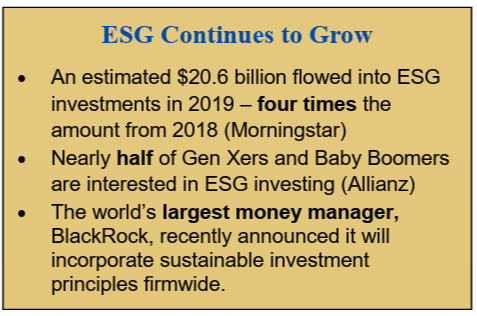
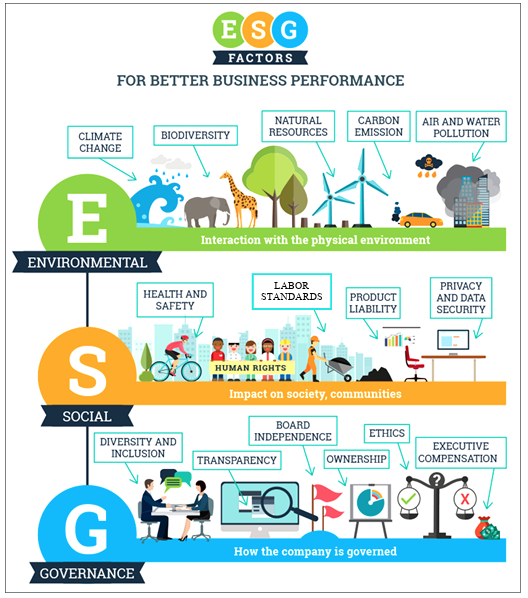
Fast forward to 2006, when the United Nations released the Principles for Responsible Investment. The overarching theme was that environmental, social, and corporate governance factors should be considered when evaluating investments. The mentality in the financial industry shifted from excluding bad actors to including companies that do good.
Companies that focus on ESG factors tend to have leaders that think creatively and plan for the long term. Organizations that treat employees well are likely to attract and retain talent. And consumers are more likely than ever before to reward a company that focuses on more than its bottom line.
Embracing ESG investing doesn’t mean you’ll be stuck investing in just technology start-ups and solar energy. In fact, it’s now possible to build a complete, diversified ESG portfolio of small and large companies, stocks and bonds, active and passive investments.
ESG does have a reputation for being expensive. Evaluating a company’s ESG metrics will always be an added cost on top of evaluating its financial statements. That said, more companies than ever are offering ESG investments, and the competition among them has driven costs down in recent years.
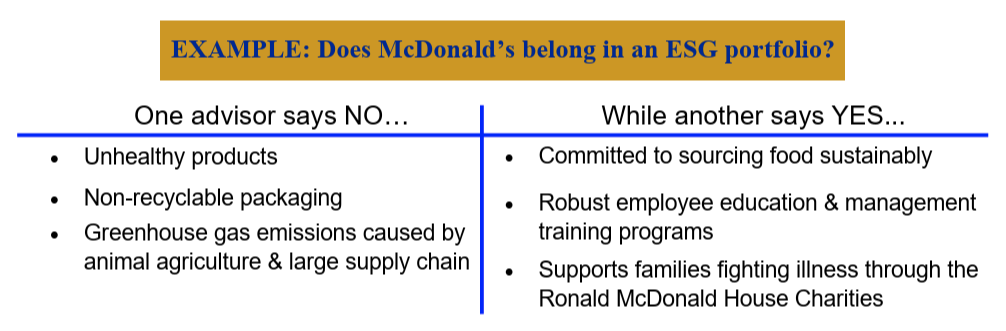
New ESG investments come out every month, and not all are created equal. Investors should work with their financial advisor to ensure that funds with “social” or “impact” in their name really are screening for ESG factors. Be aware that ESG criteria can also be subjective and hard to measure.
As an investor you should regularly ask yourself, what’s important about my money? If aligning your portfolio with your values is a priority, ESG investing can be an opportunity to do just that.
Content in this material is for general information only and not intended to provide specific advice or recommendations for any individual.
All investing involves risk including loss of principal. No strategy assures success or protects against loss. There is no guarantee that a diversified portfolio will enhance overall returns or outperform a non-diversified portfolio. Diversification does not protect against market risk.
Environmental Social Governance (ESG) investing has certain risks based on the fact that the criteria excludes securities of certain issuers for non-financial reasons and, therefore, investors may forgo some market opportunities and the universe of investments available will be smaller.
Securities and advisory services offered through LPL Financial, a registered investment advisor. Member FINRA/SIPC.